Understanding Gantry Cranes
Definition and Types of Gantry Cranes
A gantry crane is a type of overhead crane with a elevated bridge supported by free standing legs that run on wheels or along guide rails. A gantry crane provides mobility along the ground in addition to the ability to lift and move heavy loads across a broad area. The basic gantry crane design consists of a horizontal beam or bridge that spans between vertical support legs creating a portal frame structure, providing great strength and stability.
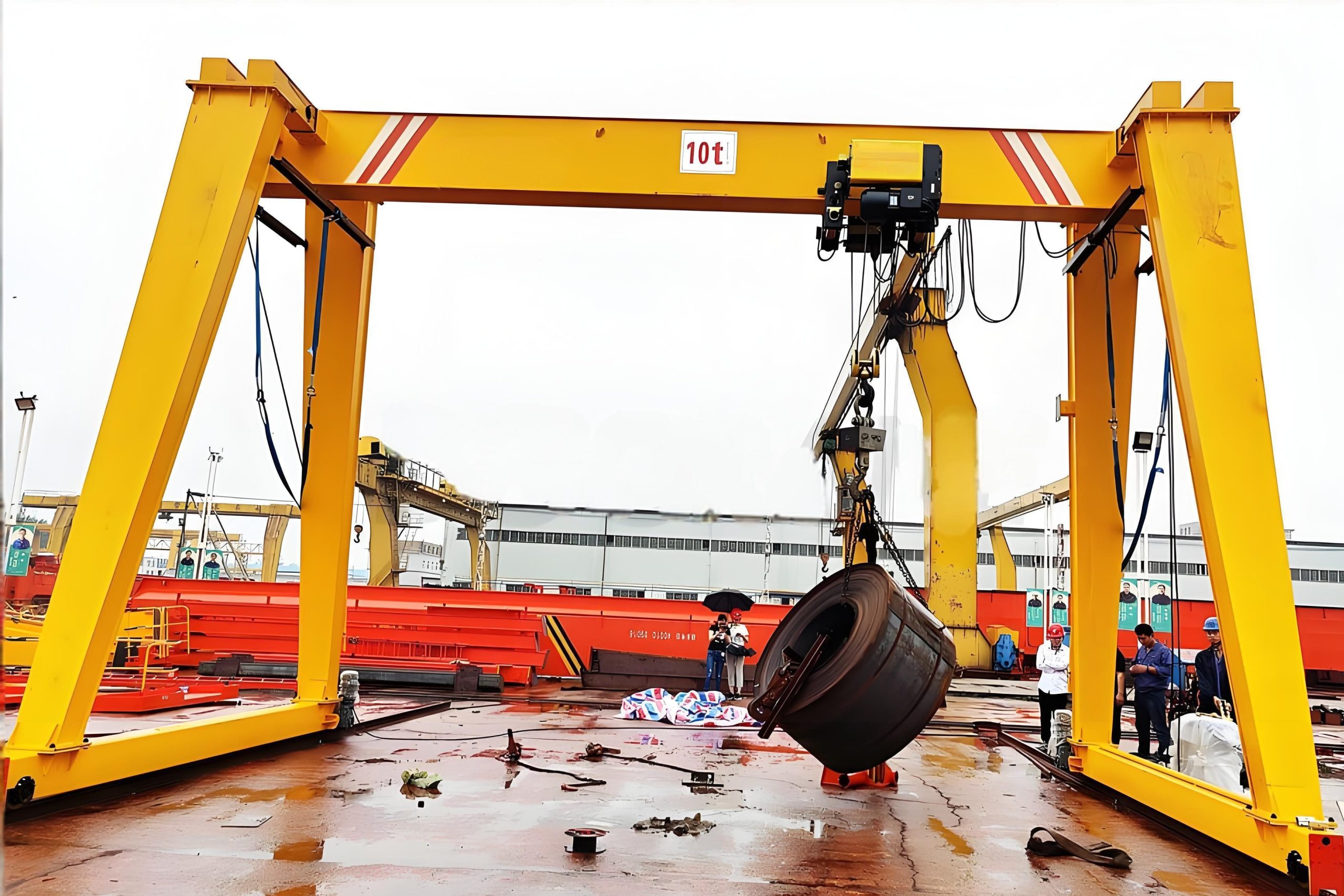
There are various types of gantry cranes that are used on a construction site, depending on the job and what is required. A full gantry crane has legs on either side of the bridge and travels on on the ground rails. This is usually used on the exterior of a site. A semi-gantry crane has one leg and a runway beam that is supported by columns in a building. This is used on the interior of a site when there is limited space. A portable gantry crane is a crane that can be moved to various points on a site. A rubber-tired gantry crane is used for a site with a varied terrain.
Gantry cranes vs tower cranes/mobile cranes Tower cranes and mobile cranes are frequently utilised on many sites but in certain circumstances a gantry crane will be the best solution. Gantry cranes do not offer a running capacity in the same way that a tower crane can be based from a small foundations with a static operating radius. Neither are they usually a replacement for a mobile crane. A gantry crane offers greater stability and the ability to lift heavier loads for longer periods. Additionally the crane can be shifted along its tracks to reach across a wider work area.
Key Components of a Gantry Crane
The bridge is the main structural part of the crane and is positioned between the two crane columns or legs and supports the crane’s hoist. The bridge is a crucial part of a crane that supports heavy loads and the crane’s movements while carrying out heavy lifting operations. The bridge is usually built using reinforced steel and it is designed with suitable load distribution in order to handle heavy loads efficiently.
The hoist of the gantry crane is the part that enables the crane to lift and move loads made of heavy materials using electric motors, wire ropes and other accessories. The hoist lifts loads vertically, enables exact positioning of loads during lifting, lowering, traversing and circulating operations on the construction site. The contemporary hoists with electronic control can control the acceleration and braking processes precisely, reducing the loads in the structure of the crane and on the load itself.
The legs support the vertical loads and part of the weight of the crane. They are designed to resists the vertical loads, the horizontal loads and the overturning moments resulting from the lifting operation. The legs are equipped with wheel attachments or rails allowing the horizontal movement of the superstructure of the crane.
High strength steel is the most common material used for gantry cranes due to high strength to weight ratio and durability. The structural components of the steel are engineered and tested to meet various safety factor and operational requirements. Special materials and coatings are used to increase the life of the structure in harsh construction environments.
Advantages of Using Gantry Cranes in Construction Projects
Enhanced Load Capacity and Flexibility
Gantry cranes are very effective in handling heavy loads, from a few tonnes up to hundreds of tonnes, depending on the particular design and configuration of the crane. They are therefore very useful in situations where heavy precast concrete components, steel structural members, heavy machinery etc. have to be placed in a construction project. Because of the distributed load path through the legs and the foundations of the crane they are also very suitable for loads that would be hard to handle for other types of cranes.
Gantry cranes are an extremely versatile piece of equipment used on a wide range of construction projects. Ideal for use both indoors and outdoors, they are very versatile and can accommodate a wide range of different types of foundations and sites, as well as various spaces. A gantry crane can be designed with almost any span length, height and mobility required to fit your project needs.
Bridge construction is another perfect example of where gantry cranes can be used. The fact that these cranes are able to cover great distances and travel along the construction route is very useful in this respect. Precast concrete construction is also an application where the positioning accuracy and heavy load capacity of gantry cranes are valuable assets. Finally, industrial construction projects which involve heavy machinery to be placed, can also benefit from gantry cranes.
Improved Safety Features
The Modern Gantry Crane includes a wide variety of modern safety features in order to ensure a low level of risk when operating and servicing the crane. By activating the load limiting system, it is possible to stop all activities involving lifting by preventing the crane from carrying loads above their permissible working loads. An anti-collision protection system offers optimal protection against the risk of collision with walls, foundations, other cranes and similar objects. It also includes an emergency stopping system.
This stability is also part of the design and means that load-swing and the danger of crane-tipping is kept to a minimum. The wide leg-base and low centre-of-gravity during operation also assures the safety of the crane during lifting of heavy loads. In addition the guides in the rails ensure exact guidance of the crane during all movements and operations.
The construction industry has a number of safety standards and regulations for gantry cranes. These cover inspections, maintenance, and operator certification. These regulations are in place to ensure that the safety features of the crane are always functioning properly and that crane operators are properly trained and certified.
Operational Efficiency and Cost-effectiveness
Time-saving Benefits in Construction Projects
Gantry cranes can significantly reduce the time required to complete a project. They are highly versatile and can undertake multiple lifts in a single trip as well as move quickly around the site. In between lifts, the crane is always available for the next lift which helps to eliminate time lost due to travelling with the crane to and from the work face. This can be particularly beneficial for repetitive lifts such as precast concrete or modular construction.
The use of gantry cranes can greatly facilitate the construction workflow as compared to conventional methods which involve a lot of manual handling of materials and also, the use of smaller equipment such as hoists, forklifts, etc. for lifting a variety of loads in sequence. In this way, the workmen can carry out the more skilled operations of the task at hand, while the heavy lifting and material movement is carried out by the crane itself, thereby making for not only faster progress, but also for greater efficiency and economy.
Cost Implications and Long-term Savings
While gantry cranes are initially quite expensive, the long-term cost savings to the operator in terms of fuel and personnel make the expense worthwhile. A well-maintained gantry crane can operate for many years, so the high upfront cost can be spread out to be a better value when compared to renting a crane for a lengthy period.
There are many savings from labor costs as a result of automation and mechanization. A single operator is able to perform more complex lifting tasks and with a higher degree of accuracy and safety. The need for handling of materials by hand is reduced thereby lowering labor costs and the danger of injury to personnel.
Technological Innovations in Gantry Cranes
Integration with Modern Technologies
These days, a large number of gantry cranes have more advanced automation and remote control systems. The work efficiency and safety performance can be therefore greatly enhanced by intelligent design. With remote control, the crane is controlled from a safe distance, still with fine-tuning of the load’s exact position. The computers in the control system are also capable of automatically controlling predefined lifting paths for the load, which further boosts operational efficiency and accuracy and also eliminates human errors that might be caused by repetitive operations.
Modern technology has an impact on the accuracy of all lifts. Using modern technology such as GPS positioning system, load monitoring sensors and automated steering system ensures more accurate and safer placing of loads reducing the risk of errors. Modern technology enables us to achieve more exacting construction tolerances and higher standards of quality on a wide range of projects.
Future Trends in Gantry Crane Development
Automation, energy efficiency and integration with ERP systems are emerging trends in gantry crane design. AI and ML technologies will be applied to optimise the sequence of lifts and to forecast when maintenance is required.
Newer, more efficient technologies are expected to be introduced in the coming years. Modern cranes may utilize Wi-Fi or a different type of wireless technology that links them directly to construction management software for example. Alternatively, newer systems may incorporate solar panels to power renewable energy collection and therefore enable cranes to run in a more environmentally-friendly manner. Another area where innovation is anticipated is in the use of new materials. As buildings continue to grow taller, manufacturers are looking for new materials that will be both lighter, yet strong enough to carry heavy loads. Such advancements are expected to improve crane functionality and utilization in construction.
Considerations for Implementing Gantry Cranes in Construction Projects
Site-specific Factors Influencing Crane Selection
Site evaluation must consider ground conditions, space constraints, and access requirements when determining gantry crane suitability. Soil bearing capacity, levelness, and drainage characteristics influence foundation requirements and overall feasibility. Additionally, overhead clearances, proximity to existing structures, and utility locations affect crane configuration and operational parameters.
Customization provides for a wide variety of applications for your equipment. They can be tailored to the needs of your specific project with customizable span lengths, variable lifting heights and various attachments for a wide range of loads.
Regulatory Compliance and Environmental Considerations
Licensing, inspections, Operator certification, safety rules All legal regulations for the operation of a gantry crane should be met in this period: licence of the crane, frequency of inspections of crane and operators, rules for safe operation, etc. Local building and labour regulations should be met as well as all other applicable rules, especially concerning the environment. A punctual inspection and maintenance record must always be available on site during the entire project period.
Noise control, emissions reduction and ground disturbance are all critical to the environmental protection of any construction project. With design and operation of the gantry crane taking full account of these considerations, effective and reliable operation can be assured. Proper planning and execution of the crane's role will maximize the advantages of crane use in the project.